

Body Responses During Exercise Include
Original Editor - Nadja Thöner
Top Contributors - Wendy Walker, Lucinda hampton, Tarina van der Stockt, Admin, Kim Jackson, Michelle Lee, Ewa Jaraczewska, Tony Lowe, Nikhil Benhur Abburi, Chelsea Mclene, Naomi O'Reilly, Shaimaa Eldib, Rucha Gadgil, Wanda van Niekerk and Evan Thomas
Introduction [edit | edit source]
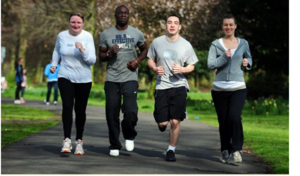
Compared to our resting state, exercise poses a substantial increment in demand for the body.
- At rest, our nervous organisation maintains a parasympathetic tone which affects the respiratory rate, cardiac output, and various metabolic processes.
- Do stimulates the sympathetic nervous system and will induce an integrated response from the body.
- This response works to maintain an appropriate level of homeostasis for the increased demand in physical, metabolic, respiratory, and cardiovascular efforts[1]
- Do challenges many human physiological systems that need to accommodate in society to maintain homeostasis, this is the inner balance of the trunk.
- While exercising, homeostasis is endangered by the increased corporeality of O2 and nutrients demand, the demand to get rid of CO2 and metabolic waste products, rising body temperature and acid imbalance and varying hormone levels.
Role [edit | edit source]
Exercise has been shown to accept many wellness benefits. Through functional exercise, we can meet benefits in just non express to:
- Cognition: Studies have shown exercising subjects to have higher concentration scores than non-exercising subjects.
- Flexibility and mobility
- Cardiovascular wellness
- Improved glycemic control and insulin sensitivity
- Mood summit
- Lower risks of cancer
- Increased bone mineral density
Through a properly executed exercise program, the body adapts and becomes more efficient at performing various exercises.[1]
These adaptations are astute and/or chronic
1. Acute Adaptations to Practise [edit | edit source]
Cardiovascular Responses [edit | edit source]
To accommodate the increased metabolic activeness in skeletal muscle, the circulatory system must properly command the transport of oxygen and carbon dioxide, as well as help to buffer the pH level of agile tissues.
- This is achieved past increasing cardiac output (increased middle rate and stroke volume) and modulating microvascular circulation.
- In addition, the action of local vasodilators such as nitric oxide from endothelial cells helps to ensure adequate claret menstruum.
1. Cardiac Output (Q) [edit | edit source]
- The corporeality of claret pumped by the left ventricle per infinitesimal is expressed as litres/infinitesimal. Q = (HR) X stroke book (SV).
- With a stepping working rate, the cardiac output increases in a well-nigh linear mode in order to meet the increased oxygen demand.
- Cardiac output is measured by echocardiography.
VO2 is the consumption of oxygen and can be explained by the Fick equation.
This equation states that VO2 = [CardiacOutput] x [Difference in arterial and venous oxygen levels].
VO2max is a measure out of aerobic exercise chapters and is defined as the highest rate of oxygen uptake an private tin can maintain during intense action.[1]
- At remainder, the value is on average almost 4-v mL/100mL of claret and
- can raise progressively during an practise upwardly to sixteen mL/100mL of blood (iv).
The 4-minute video below explains the A-V02 departure
Claret flow is preferentially shunted away from the gastrointestinal (GI) and renal systems and toward agile muscles through the selective constriction and dilation of capillary beds with increasing physical stress,[1]
- at maximal rates of work, 80 per cent of the cardiac output goes to the activated muscles and the skin
- in rest, this value is just xx per cent.
2. Blood Pressure [edit | edit source]
There is a linear increment in systolic claret force per unit area to elevation values of 200 to 249 mmHg in normotensive individuals, and the diastolic pressure level value remains near rest level.
- Hypertensive individuals reach college systolic blood pressures at a given charge per unit of work, and they can also reach higher diastolic values.
- The peripheral resistance of blood menstruation is related to vessel diameter and length and claret viscosity in the peripheral vessels.[2]
- Under physical demands the vessels dilate, increasing their diameters.
- Hypertension patients have increased peripheral resistance compared to normal, and this is a major crusade of their higher average blood pressure.
Ii to three hours mail service-exercise blood pressure drops below pre-exercising values, this is known as "post-do hypotension".
3. Coronary Circulation [edit | edit source]
Coronary arteries supply the myocardium with claret and nutrients; on average ane capillary supplies ane myocardial fibre in the ventricular walls and papillary muscles.[3]
Pulmonary System Adaptations [edit | edit source]
Pulmonary ventilation is initiated via the respiratory centre in the brainstem with parallel activation through the motor cortical drive that activates skeletal muscles and afferent Blazon Iii-IV muscle afferent fibres.
The respiratory system works in junction with the cardiovascular organisation. The pulmonary circuit receives near all of the cardiac output. In response to the increased cardiac output, perfusion increases in the noon of each lung, increasing the available surface area for gas exchange (decreased alveolar dead space).
Maximum do preparation ventilation rates in normal-sized good for you people may increase by a cistron of x, compared to ventilation rates at rest
Musculoskeletal System [edit | edit source]
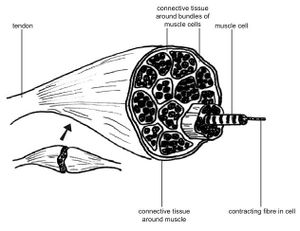
There are 3 types of muscle fibers which have unlike characteristics.
Blazon-I fibres are known equally wearisome-twitch fibres. These fibres have abundant mitochondria and myoglobin with bang-up vascular supply.
- They take: Depression myosin ATPase activeness, Loftier oxidative, Low glycolytic capacity
- These fibres are predominant in postural muscles every bit they provide low force but don't fatigue as easily as the others.
Type-IIa fibres are known every bit fast-twitch oxidative fibres.
- They have: High myosin ATPase activity, high oxidative, loftier glycolytic chapters
- Relatively resistant to fatigue
- These fibres are recruited for power activities that require sustained endeavor such as weight lifting for multiple repetitions.
Type-IIa fibres can be considered every bit the center-basis type of fibre, between the slow but fatigue-resistant blazon-I fibres and the fast only fatigue-prone type-IIb fibres.
Blazon IIb fibres are known as fast-twitch glycolytic fibres.
- They have high myosin ATPase activity, depression oxidative, loftier glycolytic activeness.
- Rapidly fatigue
- These fibres are recruited for high intensity, short-duration exercises such as full effort sprints.
With the introduction of progressively overloading exercise training, nosotros tin can expect skeletal musculus fibres to hypertrophy meaning they increase in diameter and volume.
- Muscle contraction acts upon the skeleton and initiates movement. When a progressive forcefulness is applied to the muscles over time, they will adapt to the increasing load.
- Satellite cells play a role in this repair and growth procedure.
- The process of practice (eg long-distance running or powerlifting) places a burden of stress on musculus fibres and bones which causes micro-tears and trauma.
- In response to this, satellite cells are activated and mobilized to regenerate damaged muscle tissue.
- This process is fabricated possible by the donation of girl nuclei from the satellite cells after multiplication and fusion.
- The basic will increase their mineral density over time to manage this increasing load.[i]
Resistance Do [edit | edit source]
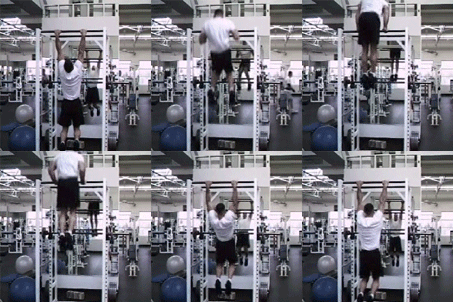
Dynamic training and forcefulness training differ primarily in the fact that resistance grooming produces a vigorous increase in peripheral vascular resistance.
- Strength training, loftier isolated forces generated in the activated musculature which compresses the pocket-size arteries and thus increases the peripheral vascular resistance.[4]
Skeletal Muscle Fibre Type [edit | edit source]
The type of physical exercise being undertaken determines the predominant muscle fibre blazon.
Endurance Preparation ( regular) [edit | edit source]
- Increases the number of mitochondria and the gas exchange capacity of the trained myofibrils.
- In marathon runners, slow-twitch fibres dominate the trained leg muscles (while sprinters possess predominantly fast-twitch fibres).
- has the potential to change the metabolic properties of skeletal muscles in the direction of an oxidative profile. The question as to how far muscle fibre types tin be reprogrammed remains open.
Hormonal Responses to Practice [edit | edit source]
Endocrine System [edit | edit source]
Plasma levels of cortisol, epinephrine, norepinephrine, and dopamine increase with maximal exercise and return to baseline after rest.
- The increment in levels is consistent with the increment in sympathetic nervous system activation of the body.
- Growth hormone is released past the pituitary gland to enhance bone and tissue growth.
- Insulin sensitivity increases later on long-term exercise.
- Testosterone levels also increment leading to enhanced growth, libido, and mood
- Catecholamines are function of cardiovascular and respiratory training adaptations and in fuel mobilisation and utilisation.
Immunological Adjustments [edit | edit source]
Moderate training enhances some components of the immune organisation and thereby reduces the susceptibility to infections. In contrast, reduced functionality of immune cells occurs later on overstraining.
2. Chronic Adaptations of Practice [edit | edit source]
Skeletal Muscle Adaptations [edit | edit source]

1. Endurance Training [edit | edit source]
Slow-twitch fibres: The cross-sectional area of dull-twitch (AKA reddish) fibres increases slightly in response to aerobic work.
Fast-twitch fibres: These fibres develop a college oxygen capacity.
Capillary bed density: Trained muscles possess a college density of capillaries than untrained muscle, which permits a greater blood flow with increased commitment of nutrients.
two. Resistance/ strength Training [edit | edit source]
Resistance training causes increased muscle size (hypertrophy) through an increase of myofibril size and the number of fast- and slow-twitch fibres. Moreover, the recruitment pathway of musculus fibres become more than effective. Resistance grooming thus leads to greater force development of the trained muscles.
Ligament and Tendon Adaptations [edit | edit source]
There is an increase in the cross-sectional area of ligaments and tendons in response to prolonged preparation, as the insertion sites between ligaments and bones and tendons and bones become stronger.
Metabolic Adaptations of Prolonged Exercise [edit | edit source]
Endurance training:
- Increases the size and number of mitochondria in the trained muscle
- The myoglobin content may sometimes increase, thus the oxygen storage chapters increases.
- Trained muscles glycogen storage capacity increases, and the ability to use fat as an energy source.
Long Term Cardiac Adaptations [edit | edit source]
When healthy individuals participate in a long term aerobic exercise program they undergo positive cardiac adaptions, both morphologically and physiological.
- Increased early diastolic filling and increased contractile strength.
- Morphological changes appear in both the left ventricle and right ventricle.
- Cardiac adaptations atomic number 82 to increased cardiac output while exercising, and a higher VO2max after exercise[five]
- Post-training heart rate is decreased at rest and during sub-maximal do.
Stroke book increases through long term endurance training.
- Endurance training increases plasma volume, which elevates the blood volume that returns to firstly the right heart and subsequently that to the left ventricle.
- The greater amount of claret in circulation causes an increase in the amount of blood in the left ventricle when the finish-diastolic phase is reached. The end-diastolic phase is the phase in which the passive filling (diastole) of the heart finishes.
- The left ventricle is fully filled and its wall is stretched.
- The passive stored energy in the wall helps to a forceful wrinkle in the emptying phase (systole).
- As a effect, the heart muscle is hypertrophied.
- Each centre muscle fibre increases in size. Hypertrophy refers to the ventricle and the posterior and septal walls.
High blood pressure = systolic claret force per unit area ≥140 and/or diastolic blood pressure level ≥xc mm Hg blood pressure. The positive correlation of blood pressure level and cardiovascular disease (CVD) gamble starts from 115 mm Hg systolic and 75 mm Hg diastolic and doubles with every xx mm Hg systolic and 10 mm Hg diastolic increase.
Co-ordinate to the American College of Sports medicine, dynamic aerobic grooming reduces blood pressure (BP) in individuals with hypertension.
- Hypertension is a chance factor for cardiovascular events.
- Endurance exercises lower arterial claret pressure for some hours subsequently a tour of exercise: this phenomenon is post-exercise hypotension.
- Post-exercise hypotension seems to be greater in people with higher pre-do claret pressure values.
- Claret pressure reductions occur after short bouts of exercises of 3 minutes duration and an intensity of 40% VO2max.
- Morphological cardiac adaptations are less in people with cardiovascular disease than when compared to younger, salubrious people. [v]
Long Term Respiratory Adaptations [edit | edit source]
The blood flow in the upper regions of the lungs increases later prolonged endurance training and the respiration rate increases.
Absolute Contraindications to Practise [edit | edit source]
Unstable Cardiovascular Illness (peripheral and central):[6] [7] astute myocardial infarction or unstable angina until stable for at least v days, dyspnoea at rest, pericarditis, myocarditis, endocarditis, symptomatic aortic stenosis, cardiomyopathy, unstable or acute eye failure, uncontrolled tachycardia.
- Fever: should be settled to avert a risk of developing myocarditis.
- Acute pulmonary embolism or pulmonary infarction. Excessive or unexplained breathlessness on exertion.
- Whatsoever acute astringent illness
- Serious musculoskeletal injury/trouble[6]
- Severely impaired cognitive functioning [6]
Precautions with Exercise [edit | edit source]
- Uncontrolled or poorly controlled asthma.
- COPD: Patients are required to be stable before training and oxygen saturation levels should be above 88-90%.
- Cancer or blood disorders: when treatment or affliction crusade leukocytes below 0.five x109/L, haemoglobin below 60g/50 or platelets below 20 x 109/Fifty.[8] If a patient has a platelet count of <20 000 and so merely AROM and ADLs are advised due to the increased risk of bleeding, twenty 000-30 000: light practice only.[9]
- Diabetes: If blood glucose is >13 mmol or <five.5 mmol/l then it should exist corrected offset.8 Patients with severe diabetic peripheral or autonomic neuropathy or human foot ulcers should be assessed before undertaking exercise.[ten] Cease exercise with diabetes with acute illness or infection.
- Hypertension: resting claret pressures of a systolic >180 or diastolic >100 or higher should receive medication before regular concrete action with particular restrictions on heavyweights strength conditioning, which can create particularly high pressures.
- Osteoporosis: avoid activities with a high risk of falling.
- Unexplained dizzy spells.
Adverse Furnishings [edit | edit source]
Musculoskeletal Agin Furnishings [edit | edit source]
Sudden force development or repetitive movements can lead to musculoskeletal strain, tear or fracture.
Cardiovascular Events [edit | edit source]
In an epidemiological study, the Prevalence of Sudden Cardiac Arrest (SCA) was studied between 2002-2013 and was compared with medical data in the USA.
- Of 1,247 cases of SCA, 63 occurred during sports activities.
- The affected persons were 51.1 ±8.8 years quondam.
- The incidence is 21.7 (95% -CI 8.1-35.4) per million per year and varies based on sex for sports SCA.
- Men possess a Hazard Ratio of 2.58 (95%-CI ii.12-iii.13)
Another study investigated the US National Registry of Sudden Death in Athletes. They found
- A total of 2406 deaths between the years 1980-2011.
- The young athletes were 19 ±6 years old and were engaged in 29 diverse sports.
- Young men were affected 6.five times more often than women.
- The most common reason was hypertrophic cardiomyopathy.
References [edit | edit source]
- ↑ one.0 one.1 1.2 1.3 1.4 Patel PN, Zwibel H. Physiology, practice. InStatPearls [Net] 2019 May 5. StatPearls Publishing. Available from:https://world wide web.ncbi.nlm.nih.gov/books/NBK482280/ (last accessed 16.two.2020)
- ↑ Benjamin Cummings Publishing Co. Factors that affect blood pressure. Available online at:http://www.interactivephysiology.com/demo/misc/assignmentfiles/cardiovascular/Fact_Aff_Blood_Pressure.pdf [Accessed 3 Dec 2018]
- ↑ Joseph T. Wearn. The extent of the capillary bed of the heart. J Exp Med. 1928 Jan 31; 47(ii): 273–290.
- ↑ Pescatello LS, Franklin BA, Fagard R, Farquhar WB, Kelley GA, Ray CA; American College of Sports Medicine position stand. Exercise and hypertension.Med Sci Sports Exerc. 2004 Mar;36(iii):533-53.
- ↑ 5.0 5.1 Lavie CJ, Arena R, Swift DL, Johannsen NM, Sui X, Lee DC, Earnest CP, Church TS, O'keefe JH, Milani RV, Blair SN. Practise and the cardiovascular organization: clinical science and cardiovascular outcomes. Circulation research. 2015 Jul 3;117(two):207-19.
- ↑ 6.0 6.ane 6.2 Spruit MA, Burtin C, De Boever P, Langer D, Vogiatzis I, Wouters EF, Franssen FM. COPD and practice: does it make a departure?. Exhale. 2016 Jun i;12(2):e38-49.
- ↑ Spruit MA, Singh SJ, Garvey C, ZuWallack R, Nici L, Rochester C, Loma K, Holland AE, Lareau SC, Man WD, Pitta F. An official American Thoracic Society/European Respiratory Order statement: key concepts and advances in pulmonary rehabilitation. American periodical of respiratory and critical care medicine. 2013 Oct 15;188(8):e13-64
- ↑ O'Halloran, P and Bhogal, G (Eds). Exercise Medicine for Students: A one-stop resource for the noesis and promotion of the physical activity. Motivate2Move
- ↑ O'Sullivan SB, Siegelman RP, editors. National Physical Therapy Examination: Review & Report Guide. Therapy Ed; 2021. Available at: https://world wide web.therapyed.com/physical-therapy/review-study-guide [final accessed 9.12.2021]
- ↑ Colberg SR, Sigal RJ, Fernhall B, et al. Exercise and type ii diabetes: the American College of Sports Medicine and the American Diabetes Association: a joint position statement. Diabetes Intendance. 2010;33(12):e147-67.

Body Responses During Exercise Include,
Source: https://www.physio-pedia.com/Exercise_Physiology
Posted by: paynefarmay.blogspot.com
0 Response to "Body Responses During Exercise Include"
Post a Comment