

Can I Get Text Message Records From Verizon
Cellular telephone forensics company Cellebrite recently gained national notoriety for its rumored assistance in keen the countersign of an iPhone related to the San Bernardino murders. What many practitioners don't know is that the FBI, DOJ and the SEC take been using Cellebrite'southward forensic cell-phone cracking tools for years. While the employ of its products to get past passcodes might have garnered more public acclamation, i of the other less well known features is its ability to chop-chop uncover information that might take been previously unrecoverable, including deleted data and text messages.
A. The Text of Texts Are Often Merely Available On The Device Itself
Cellular service providers retain records of the parties to a text message and the engagement and fourth dimension it was sent. They practise not, still, retain the content of text messages for very long, if at all.
In 2010, the American Civil Liberties Wedlock ("ACLU") served a Liberty of Information Human action ("FOIA") request to the Department of Justice seeking an internal memorandum regarding the information memory plan of major cellular service providers. The memorandum contained data from the vi largest prison cell phone carriers in the United States: Verizon, T-Mobile, AT&T/Cingular, Dart, Nextel and Virgin Mobile. All of the providers retained records of the date and time of the text bulletin and the parties to the bulletin for time periods ranging from sixty days to seven years.
Nevertheless, the bulk of cellular service providers practise not save the content of text messages at all. As of 2010, Verizon Wireless saved text message content for three to v days while Virgin Mobile retained text message content for 90 days but stated that it would but disclose that content if police force enforcement had a search warrant containing a "text of text" asking. As recently equally November 25, 2015, T-Mobile'south privacy policy indicated that it retained "calls and text messages you ship and receive (but we do not retain the content of those calls or letters later on delivery)." Nathan Freitas, a fellow at the Berkman Center for Internet and Guild at Harvard University explained that the carrier may accept "details of whom [was]texted and when" but "the bodily text is what is really hard to get, if non incommunicable" from the carrier. The Boston Globe reported that carriers, including the four biggest in the country ‑ AT&T, Verizon, T-Mobile and Sprint ‑ have publicly confirmed that they delete their copies of messages subsequently delivering them.
Legislators have resisted attempts to strength retentiveness of content. Indeed, various law enforcement groups, including the Major Cities Chiefs Law Clan, the National District Attorneys Clan, the National Sheriffs' Clan, and the Association of State Criminal Investigative Agencies, asked the U.S. Senate to force cellular service providers to retain the substance of text messages for at to the lowest degree two years. The proponents sought an amendment to the Electronic Communications Privacy Human action of 1986 to require service providers to retain the substance of text messages. On March nineteen, 2013, a House subcommittee held a Hearing on this result. A proponent of increased text message retention plans Richard Littlehale from the Tennessee Bureau of Investigation explained:
"most cellular service providers do non retain stored text messages accessible to law enforcement for any time at all. Billions of texts are sent every day, and some surely incorporate key testify about criminal activity. In some cases, this means that critical evidence is lost. I am well aware that retention means a price for service providers. I would urge Congress to notice a residue that is not overly burdensome to service providers, but that ensures that constabulary enforcement can obtain access to critical evidence with appropriate legal process for at least some period of fourth dimension."
No such bill was passed and presently there is no police explicitly requiring cellular providers to store the substance of their customers' text letters. However, the text of texts that take been deleted exterior of cellular service providers' retentiveness schedules can still be recovered from one place: the device itself.
B. When Is A Text Bulletin Actually Deleted?
Many experts respond with the answer: virtually never. Nearly phones utilize "flash memory" which but actually deletes a deleted SMS bulletin when the rest of the device'due south information infinite has been exhausted by new data. Paul Luehr a old federal prosecutor and former supervisor of the internet fraud program at the Federal Trade Commission has explained that "[d]eleted text messages just sit down in that location until they're overwritten" and "most phone systems operate on a database, and then the data may however be there marked with a flag that says deleted." Luehr also reiterated the point that in well-nigh circumstances in order to recover deleted text messages "yous really need to take access to 1 or more physical devices."
Cybersecurity good John J. Carney has opined that simply deleting a text message but hides information technology from apparently sight but "it's still in in that location, it's simply marked equally 'erased' . . . it'due south possible to go in there and collect them." Moreover, Carney's interview indicated that, in light of this emerging cell phone forensics technology, "many common methods for intentionally destroying phones do not make text messages and other data irretrievable." "For example, shattering a device's screen, breaking its charging ports or on-off switches, crushing it under weight, or submerging it in h2o are unlikely to wipe out the memory."
C. Cellebrite'due south UFED Device Tin can Recover Deleted Text Messages
According to computer forensics expert and applied science professor Bradley Schatz, about prison cell phones are "set upwards to avoid indiscriminately overwriting data, so if you have a lot of spare space on the drive inside your phone, which y'all volition exercise on a large iPhone, and so the device volition apply that before it writes over or erases previously used space and deleted messages." As most practitioners mostly know, when a user deletes a text message, it is about ever recoverable through the forensic procedure. That is one key reason why federal investigators and litigants have been asking for the concrete cellular phones of targets, witnesses and counterparties. A former Master of the SEC's Net Enforcement office stated: "[t]he central to just about every important SEC investigation nowadays lies in the data that the Staff finds . . . occasionally yous take wiretaps or a whistleblower, but generally, the disquisitional smoking gun resides on some device as a byte of data." Critical for the purpose of electronic information recovery and harvesting, Cellebrite's primary product, the Universal Forensic Extraction Device ("UFED"), has the ability to recover deleted text messages from cellular phone devices.
Cellebrite's primary offices are located in Tel Aviv, Israel and it is a wholly owned subsidiary of the Sun Corporation, a public Japanese company. According to Cellebrite, its UFED Series is the prime choice of forensic specialists in police force enforcement, armed forces, intelligence, and corporate security and eDiscovery agencies in more than 100 countries. The Cellebrite website describes the UFED every bit a product that "enables physical, file system, and logical extractions of all data and passwords, included deleted data, from the widest range of mobile devices." Further, a number of testimonial videos explicate how law enforcement has been using the UFED during the course of investigations.
- One Canadian police enforcement agent described the utilise of the UFED in a homicide investigation: "one of the cases that comes to listen was being able to recover deleted letters off of a phone that was deleted intentionally by the doubtable . . . we recovered non simply pictures that were critical to the investigation as well equally a week'south worth of text messages that were disquisitional to a serious homicide investigation."
- A detective from Wisconsin reported "the well-nigh recent one probably may be a shaken infant case where the suspect ran over his iPhone to effort to destroy evidence on the phone we were able to do some physical repair on the telephone itself and then use the UFED physical to recover data from the telephone and recovered some deleted text messages direct related to the criminal offence."
- A detective on the Sacramento Valley High Tech Crimes Strength explained "everybody wants deleted information, and its generally deleted text messages then I have worked very closely with Cellebrite to accept them provide deleted data for united states of america. That was a big thing getting physical data, because that's what everybody wants, everybody wants the deleted data, we practice homicide cases, child pornography [cases], fraud cases, when yous're dealing with loftier profile cases they want all the data including the deleted stuff." He further described a homicide investigation where the police discovered a soaking moisture iPhone, with a shattered screen, that had been buried and was cloak-and-dagger for at least two weeks. When he looked through the telephone himself, he establish ten text messages and nearly twenty voicemails. When he used the UFED he recoverd 80,000 text messages and about twenty,000 voicemails. "The text messages had the 2 guys texting each other about the excuse that they were going to tell the law if they got caught."
In addition to the testimonials, Cellebrite has posted numerous videos online which display the UFED's power to disable prison cell phone passcodes and excerpt the telephone's information.[1]
According to a study published by the New Jersey Constabulary Journal, the UFED was able to "bank check a phone for deleted text messages, email, [and]voice mails." "UFED extracts relevant information from Skype, Google Vocalisation and even Words With Friends, which has a built-in chat customer." "We've had so many cases where people were using [Words With Friends] to communicate, thinking information technology doesn't leave a trace, but UFED does a actually good job of parsing out and making viewable the unlike information types that these apps store." Moreover, the device allows the user to pinpoint only those communications between certain parties.
In a case involving the employ of the Cellebrite past a Homeland Security agent, a Federal District Court wrote that the agent "examined [accused'southward] cell phone using CelleBrite software, which extracted all data (including deleted information) from the phone." U.s.a. 5. Smasal, No. 15-cr-85, 2015 WL 4622246, at *4 (D. Minn. June 19, 2015). "That process took approximately ten to fifteen minutes . . ." Id. The Seventh Excursion explained that by using the UFED information technology is "possible to 'mirror' (copy) the entire cell phone contents, to preserve them should the phone be remotely wiped." Usa v. Flores-Lopes, 670 F.3d 803, 809 (7th Cir. 2012) (citing the Cellebrite website).[ii] In order to complete a copy, the cell phone would have to be directly plugged into the UFED. The UFED so creates a forensic copy of all of the phone's information. Information technology produces a comprehensive report that categorizes the information and makes it relatively piece of cake to sympathise.
The UFED can also recover deleted Blackberry Messenger ("BBM") letters, a text messaging application exclusive to Blackberry devices. This ability is critical for investigators because according to Blackberry Support,"[t]he Blackberry Messenger database does non go along permanent records of conversations between Blackberry Messenger users." "The chat contents are kept only as long as the conversation is open." Considering of the limited data retained with respect to BBMs they are a communication medium of option for some criminal organizations. Business Wire reports that "organized criminals in particular have relied on encrypted BBM communications to 'hide' their activities from the constabulary" and CNN referred to an Italian crime grouping, the 'Ndrangheta, who was reported to have communicated overseas with the Gulf Cartel, a Mexican drug cartel, with BBMs because they are normally difficult to intercept. BBMs take previously been used to hide conversations, but now, the UFED can recover this information.
D. The SEC And Other Federal Investigators Have Been Using Cellebrite'south Technology For Years
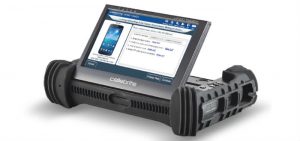
Since September 27, 2012, the SEC has been contracting with Cellebrite for its UFED "Ruggedized System." In 2014, the SEC gave detect of its intention to sole source the UFED with software updates for two option years. The SEC justifies these sole source contracts by explaining that the UFED device tin can extract a wealth of information from 95% of jail cell phones with a specialty in extracting deleted data.
The Federal Bureau of Investigation ("FBI") contracted with Cellebrite for the UFED in 2009, 2012 (there were 2 contracts in 2012), 2013, 2014, 2015 and 2016 for the UFED. Similarly, the Drug Enforcement Agency purchased Cellebrite tools in 2015 and requested additional devices and training in 2016. Other federal authorities, including the Section of Homeland Security, Army, Navy and Hush-hush Service have also contracted with Cellebrite. In addition, as of July 28, 2015, Cellebrite's UFED products and applications have been made "bachelor to federal government agencies under NASA's Solutions for Enterprise-Broad Procurement contract and National Institutes of Health CIO-Commodities Solutions" which allows federal police enforcement agencies to "streamline procurement of Cellebrite's UFED mobile forensics solutions" without going through the ordinary (and often time-intensive) behest and procurement process.
Presently after the SEC's starting time contract with Cellebrite, on January xiii, 2013, the SEC allowed CNBC into its law-breaking lab and put their jail cell phone forensics technology on brandish. According to CNBC "if the SEC shows upward with a subpoena asking for your hard bulldoze and your cell telephone records you should know that using passcodes and even deleting those files won't protect your information." Adam Storch, the COO of SEC's Enforcement Partitioning took CNBC through its "jail cell phone room" and explained that they were able to recover data from a prison cell telephone that was purposely disfigured. Too, the SEC typically places the cell phones it acquires in metallic boxes that block all outside signals from reaching it "because if nosotros turn the device on and its able to access outside signals somebody could be able to remotely delete files from it, remotely wipe the device, emails or messages could showtime being sent in and out and what we actually aim to do is to maintain the security and integrity of the information the mode that nosotros received it initially." Scott Friestad, the acquaintance director of the SEC's enforcement partitioning, has revealed that the SEC'due south new forensics facility focuses on recovering deleted prove which has been particularly helpful in insider trading investigations to find communications betwixt tippers and tippees.
The Second Excursion has upheld Cellebrite-related testimony from an FBI Special Agent who "explained his training in the use of Cellebrite applied science to retrieve text messages and other information from a cellular phone; described how he used Cellebrite to practice so in this case; and testified that he confirmed the results by checking the letters on the phone itself." United states v. Marsh, 568 F. App'x fifteen, 17 (2d Cir. 2014) cert denied 135 S.Ct. 111 (2014) (affirming conviction). Reported case police indicates widespread usage of the Cellebrite past police force enforcement by various federal agencies as well equally state and local police departments. [three]
E. Conclusion
As it turns out, Cellebrite'southward then-chosen "new" space-age devices rumored to have been used in the San Bernardino case accept actually been utilized by law enforcement for years. It is important for practitioners to inform their clients as to the sort of information – including previously "deleted" information – that can exist recovered from their cellular phones.
[one] https://www.youtube.com/lookout?v=odcFWueoaeA (Galaxy); https://www.youtube.com/watch?v=q-L4T2C9xxA (Samsung Android); https://www.youtube.com/lookout?5=YE_uSkFsSyg (HTC); https://www.youtube.com/watch?five=AUgmnYChT48 (iOS).
Equally new phones are released and new phone security applications are created, Cellebrite will accept to go on to adapt its product. It is possible that there are sure passcode protections on operating systems that the UFED is not yet able to cleft.
[2] A remote "wipe" or "mill reset" occurs when a user remotely deletes information and reverts the cell phone back to its original state, as if it were to be resold.
[3] See e.chiliad., The states v. Reilly, No. 14-cr-146, 2015 WL 4429415 (Due north.D.Ga. July 20, 2015) (FBI); U.s.a. v. Djibo, No. 15-cr-88, 2015 WL 9274916 (E.D.N.Y. Dec. 16, 2014) (United States Department of Homeland Security, Homeland Security Investigations); Us v. Smasal, No. 15-cr-85, 2015 WL 4622246 (D. Minn. June 19, 2015) (same); U.s.a. v. Martinez, No. thirteen-cr-3560, 2014 WL 3671271 (S.D.Ca. July 22, 2014) (aforementioned); United States v. Nyun, No. 12-cr-40017, 2013 WL 1339713 (D.S.D. Mar. 7, 2013)(same); United states of america five. Clinton, No. 12-cr-40018, 2012 WL 5185746 (D.Due south.D October. 17, 2012)(aforementioned); Us v. Mayo, No. two:xiii-cr-48, 2013 WL 5945802 (D.Vt. Nov. 6, 2013)(DEA); United States five. Dixon, No. 12-cr-205, 2013 WL 4718934 (Due north.D.Ga. Sep. three, 2013) (Agency of Alcohol Tobacco and Firearms); United States v. Tienter, No. NMCCA-201400205, 2014 WL 4716290 (Due north-M. Ct. Crim. App. Sep. 23, 2014)(United States Marine Corp., Criminal Investigation Division); United States 5. Garden, No. iv:fourteen-cr-3072, 2015 WL 6039174 (D. Neb. June 29, 2015)(Nebraska State Patrol); U.s.a. five. Winn, 79 F. Supp. 3d 904 (S.D. Ill. 2015) (St. Clair Canton Sheriff's Department); United States 5. Zaaverda, No. 12-cr-156, 2013 WL 6438981 (Northward.D. Okl. 2013) (Oklahoma City Police force); Foster five. State, No. 05-xiv-cr-01186, 2015 WL 8039901 (Tex. Crim. App. December. seven, 2015) (Collin County Sheriff'south Part); In re D.H., No. A140779, 2015 WL 514336 (Cal Ct. App. Feb. 6, 2015)(San Francisco Police); Washington v. State, No. ii-thirteen-00526-cr, 2015 WL 505172, at *two (Tex. Crim. App. June 17, 2015)(Lewisville Police Department); Country five. Pratt, 128 A.3d 883 (Sup. Ct. Vt. 2015)(Vermont law officers. Noting that "[a]handful of courts have considered testimony regarding the employ of the Cellebrite software and accept ruled the testimony admissible."); People v. Smith, 2015 WL 5224708 (Cal. Ct. App. Sep. 4, 2015) (California police officers).
*Joseph Evans is an Associate at Cuff Spencer & Fleming LLP

Can I Get Text Message Records From Verizon,
Source: https://news.law.fordham.edu/jcfl/2016/06/02/cell-phone-forensics-powerful-tools-wielded-by-federal-investigators/
Posted by: paynefarmay.blogspot.com
0 Response to "Can I Get Text Message Records From Verizon"
Post a Comment